| ⌠ Task: Before taking Math 10, what is Mathematics for you? What are the things you like and don't like about maths?⌡ |
|---|
| Before taking Math 10, I always viewed Mathematics as something that was just purely numerical. I've always liked it every time I understand the lesson and get the right answer, the feeling is always so satisfying. I dislike it when I find the topic very hard for me to digest. |
| ⌠ Task: List and explain five of your favorite topics—or topics that have fascinated you—in the history of Mathematics.⌡ |
|---|
| Abacus – I find it cool because it’s one of the oldest tools used for counting. It shows how ancient people were already creative with Math even without calculators, and it proves how smart they were in solving problems with simple tools.\ |
| Pythagorean Theorem – It fascinates me because it’s such an old formula, but it is still being used today in measuring distances and building things. |
| Fibonacci Sequence – I had this listed since this sequence has a very special place in my heart. It is a series of numbers where each number is the sum of the two preceding ones, usually starting with 0 and 1; 0,1,1,2,3,5,8,13..., so on. It is cool because if you look very closely at the things around you, you can see it in art and nature. This sequence makes me see Math in the world around me. |
| Calculus – It is a branch of mathematics that studies continuous change. Even though it seems hard, I find it interesting because it helps explain how things change over time, like speed, motion, and growth. |
| Set Theory – Georg Cantor’s set theory is fascinating because he helped create the modern idea of sets (collections of objects or numbers) which is now a fundamental theory of modern mathematics. |
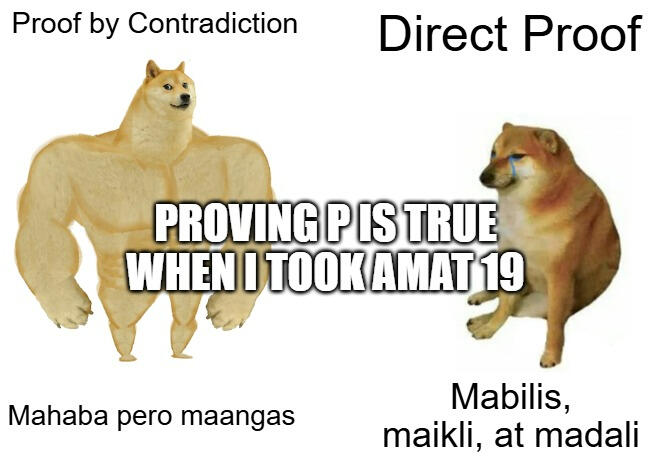
| ⌠ Task 1: Create a Logic Meme (Filipino style)⌡ |
|---|
| I made this meme as I remembered my first semester in UPLB. |
| ⌠ Task 2: Find a news article, social media post, or any online content that exhibits invalid logical reasoning or logical fallacies. Identify the specific fallacy and explain the correct reasoning that should have been used.⌡ |
|---|
| I'm sure everyone knows Danny Calcaben, if not everyone, then most Math majors know him. So, I'm going to talk about Danny Calcaben and the time he wrote a letter to the President. |
| Claim: Danny Calcaben, a public high school teacher from San Narciso, Quezon, claimed to have discovered a formula that solves the Goldbach and Twin Prime conjectures, two longstanding unsolved problems in mathematics. He sought protection for his discovery by writing a letter to President Ferdinand Marcos Jr., expressing concerns about potential plagiarism. |
| Logical Fallacy: Appeal to Authority |
| Explanation: An Appeal to Authority occurs when someone asserts that a claim is true based on the authority of an individual or institution, rather than presenting empirical evidence or logical reasoning. Calcaben's case is an example of this fallacy. While the President holds political authority, he does not possess the expertise required to validate mathematical proofs. |
| Correct Reasoning: Mathematical discoveries should undergo peer review by qualified mathematicians and be published in reputable academic journals to establish credibility. This process ensures that the findings are scrutinized and validated by experts in the field. Additionally, the Intellectual Property Office of the Philippines (IPOPHL) clarified that mathematical formulas cannot be patented under current laws, as they are considered facts and part of the public domain. |
| Conclusion: While Calcaben's enthusiasm for his discovery is commendable, relying on political figures for validation of scientific claims undermines the rigorous standards of academic research and intellectual property laws. |
| ⌠ Task: Pick one branch of Math, find an exciting topic, and present it in a video (minimum of 5 mins, maximum of 10 mins).⌡ |
|---|
| Google Drive link down below: |
| https://drive.google.com/file/d/1t1HHw2B-EuQ6AiU1pU_jBXqIvIDzfbEw/view?usp=sharing |
| ⌠Task: Based on your own thoughts, what philosophy/ies do you subscribe to? Explain.⌡ |
|---|
| Personally, I lean toward Formalism and Intuitionism because I see Math both as a structured system like playing a complex but logical game with rules and as something I build and understand in my own mind through learning and practice. To me, Math becomes real not just because it exists “out there” but because I interact with it, whether I’m solving a problem in class, analyzing data for my organization, or even trying to solve my Pyraminx cube. It’s the patterns, logic, and mental construction that make math meaningful and powerful. |
| ⌠ Task: What are your thoughts on proving statements deductively? Do you find it useful? Why or why not?⌡ |
|---|
| Proving statements deductively is a fundamental aspect of mathematical thinking because it ensures that conclusions are logically sound and based on established truths. It is very useful since it helps us develop critical thinking skills applicable not just in Math but also in other fields. By following a structured and logical progression, deductive proofs eliminate doubt and ambiguity, allowing us to arrive at conclusions that are universally valid and reliable. |
| ⌠Task: What is your favorite number? Create something creative about this number.⌡ |
|---|
| My favorite number is 8. It's just so cool because if you turn it sideways, it's now infinity. And now presenting a haiku about "Eight." |
Seven ate poor nine,
Eight called Math Emergency,
“Someone’s skipping line!”
| ⌠ Task: What is your idea of Algebra before this lecture? Did it change? Explain.⌡ |
|---|
| Before this lecture, like ever since elementary, I saw Algebra as just solving for x in equations, like it's so boring why do we need to find x? Just kidding, I love love Algebra so much. I enjoyed solving it. But anyway, after the lecture, I realized it's a powerful language that models real-life problems, explores structures like groups and fields, and connects abstract ideas to practical applications like budgeting, dieting, and even logic circuits. |
| ⌠ Task: What is your favorite geometrical shape/structure? Create something creative about this shape. Also, discuss how this shape is relevant in our lives.⌡ |
|---|
| I like the triangle. It's so simple yet strong since structurally, it's the most stable shape, which is why it’s used in buildings, bridges, and even trusses. Mathematically, triangles help us understand angles, forces, and relationships in space, making them essential in fields like engineering, design, and even data science. Triangles are everywhere. I like this shape totally not because I like solving a Pyraminx. And for that, here is another haiku: |
Three points, one strong base,
Like my Pyraminx I hold,
Pizza, roof, and grace.
| ⌠ Task: In what ways do you think Calculus is useful in your life and future endeavors?⌡ |
|---|
| Even though Calculus has been my greatest enemy in my freshman year, it is useful in my life and for the future because it helps me understand how things change and grow over time, which is important for solving real-world problems. Since I plan to study actuarial science, calculus will help me analyze risks, predict trends, and make smart financial decisions that protect people and companies. I can use math to create solutions that help others plan for the future, like managing insurance, investments, or even public safety, making my work meaningful and impactful. |
| ⌠ Task: In what ways do you think Statistics/Data Science is useful in your life as a student? Provide at least 10 examples.⌡ |
|---|
| Statistics and Data Science are useful because they teach me how to collect, analyze, and interpret information to make better decisions and understand the world around me. As a student, these skills help me handle data more confidently, whether in research, school projects, or everyday life. The following are 10 ways I can use it: |
| 1. Understanding survey results for school projects. |
| 2. Analyzing data from experiments in science class. |
| 3. Tracking my own study habits and performance to optimize my time management. |
| 4. Interpreting graphs and charts in textbooks or news. |
| 5. Making data-driven decisions instead of relying on assumptions in both academics and org work. |
| 6. Evaluating the effectiveness of different learning techniques. |
| 7. Predicting exam scores based on past performance. |
| 8. Organizing and summarizing complex data clearly for reports, proposals, or meetings. |
| 9. Applying data science skills during my internship to solve real business problems. |
| 10. Building a strong foundation in data analysis that’s valuable for future career opportunities in fields like actuarial science, finance, or technology. |